The Elements Every Successful Brand Ambassador Program Needs
When it comes to selling, no one is quite as persuasive as the people who have already bought from you. Even the world’s most talented copywriter or best marketing strategist couldn’t touch the effectiveness of an unbiased third party who has tons of great things to say about a business.
Brand ambassador programs are designed to harness that power and incentivize influential individuals to promote your brand for you, and last week’s #SEMrushchat dove deep into what these programs are and how to build them. Digital marketer and brand ambassador specialist, Mack Collier joined us to share his knowledge on the subject. See what he and our other chat participants had to say so you can get your ambassador program started off on the right foot!
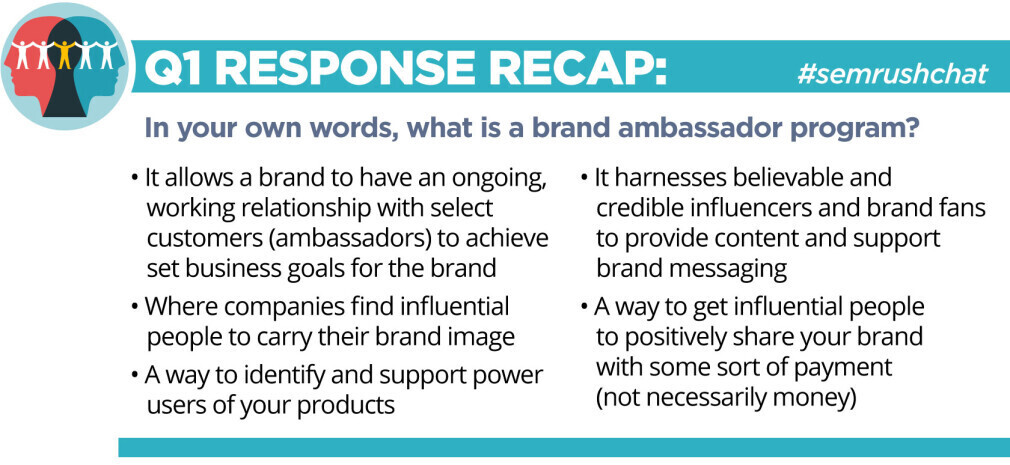
Q1. In your own words, what is a brand ambassador program?
Mack Collie,r unsurprisingly, was able to sufficiently and accurately define a brand ambassador program in just a few words, stating that it is “where a brand has an ongoing working relationship with select customers (ambassadors) in order to achieve certain business goals.”
A1. I like this from @EntMagazine “By definition, a brand ambassador, unlike a celebrity spokesperson, is someone who eats, lives and breathes your brand.” https://t.co/VOq4mrBtdb Not my words but it is concise. #SEMrushchat
— Gene Petrov // Leadership & Management Consulting (@GenePetrovLMC) January 24, 2018
In many cases, these goals may be directly tied to brand awareness, lead generation, or increased sales. They work by allowing companies to find influential users to help them carry and support their brand image. In many cases, these individuals may be “power users” of your products, or loyal customers who are already advocates of your brand or close to it. These users are often passionate about what you do and more than happy to spread the word through word-of-mouth marketing.
a1) Harnessing believable and credible influencers/brand fans to provide content and support messaging. #semrushchat
— Ryan Johnson (@rsj8000) January 24, 2018
Brand ambassador programs should have methods of identifying and supporting brand advocates in their word of mouth marketing for your business. This means finding influential people who are both credible and believable, as they will be most effective when spreading your brand’s message. It is why three passionate customers or small bloggers may be better for your brand ambassador program than trying to recruit big names that people don’t trust or find authentic. These programs should also provide the necessary resources to brand advocates to help them spread the message.
These programs often incentivize brand advocates to share your brand, not unlike affiliate programs. Some incentives may be financial, though they don’t have to be purely monetary; brand ambassador programs use everything from discounts to free gifts to exclusive invitations to events to reward ambassadors.
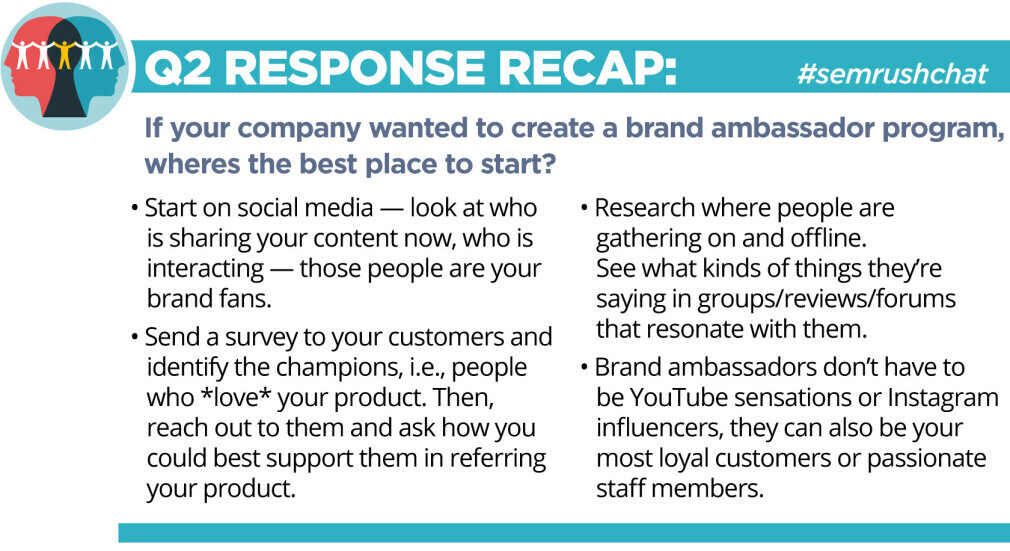
Q2. If your company wanted to create a brand ambassador program, where is the best place to start?
Creating a great brand ambassador program starts with finding the right people to become brand ambassadors.
To best identify your strongest brand advocates, start looking on social media. You can use social listening tools like SEMrush’s brand monitoring tool to see who is sharing your content and what they are saying about it. You can find your most enthusiastic brand fans this way and reach out to them. The best advocates, after all, will already be happily talking about your brand. Taking a look at customers who interact most frequently and enthusiastically with your own social content.
A2. I look for the ones who already love our brand. We are lucky to have quite a few of them. We sell DIY products, so if I see them posting photos of the product, I simply reach out to them. #SEMRushChat
— Doris Shadouh (@DShadouh) January 24, 2018
A2) Social – who’s sharing your brand and how is it being shared? #semrushchat
— Nathan Driver (@natedriver) January 24, 2018
You can also send out a survey to your customers through email and identify the “champions” of your brand, so to speak. These customers will happily take the survey and give you detailed feedback about your brand. Find ones who not only love your product but seem to be invested in it. You can then reach out to them and ask how you could best support them in referring your product to others.
A2: Who has shared a positive experience of your company in the past? Start looking at those people to narrow your selection of brand ambassadors. #SEMrushchat
— Netvantage Marketing (@netvantage) January 24, 2018
Once you have identified who your brand ambassadors could be, you will want to get a clear understanding of how both your brand and your ambassadors will benefit separately. This is important because it will be a crucial part of how successful your program is both immediately and long-term.
A2 Too many brands give a lot of thought to how a brand ambassador program would benefit their brand, and little thought to what’s in it for the ambassadors. The ambassadors should be able to look at your program’s benefits and JUMP at the chance to be involved #semrushchat
— Mack Collier (@MackCollier) January 24, 2018
A2: To start brand ambassador program – Identify what goals you want to achieve whit that and also do a research and identify the right people for that program #SEMrushchat
— SoPro (@SoPro_London) January 24, 2018
You can also research to see where people are gathering both on and offline in venues that aren’t directly connected to your platform. Writers like to converge at coffee shops, for example, and college students may be found near the local bars. Online, people may be engaging in forums or groups. See what they are saying, and see what resonates with them.
A2. I also stumbled on a group of folks who are interested in products like ours. I started adding more customers to the group, and who ever seems to be the most active, I reach out to them as well. #SEMRushChat
— Doris Shadouh (@DShadouh) January 24, 2018
Remember that brand ambassadors don’t have to be YouTube sensations or Instagram influencers. In fact, it may be better that they are not. Utilizing your brand ambassador program to incentivize your most loyal customers and passionate employees to promote your brand may actually be more effective as it could be seen as more authentic. Focus on real customers and people who care about your brand already, and leave the social media stars for the influencer marketing strategies.
Q3. How do you determine how many ambassadors will be in your brand ambassador program?
After you have decided on goals, strategies, and who want to include in your ambassador program, you will also need to decide how big you want the program to be. How many ambassadors should you bring on? This will depend on a number of different factors.
First, take a look at your budget and your goal. When starting out, these two things should lead your brand ambassador strategy.
In many cases, it’s best to start the programs small with loyal advocates that you trust most, and who are in the best position to promote your brand. Be inclusive, and find out what they will need and how will can meet their needs. Nurture them.This also gives you a chance to see how effective different strategies are and be able to advice future advocates more effeciently from the get-go. As you see fit, you can scale from there.
A3 THat’s good – you will need to nurture your first ambassadoys – cannot ignore them for the new ones.
#SEMRushChat https://t.co/2rqtCnV4hj
— Simon Cox (@simoncox) January 24, 2018
As you are scaling, you can craft your program to have different levels, with a tiered level of benefits. This can help keep you from turning away people who could still do good for your brand while incentivizing results from your best advocates.
Theoretically, you should bring on as many ambassadors as you see fit to achieve your goals. That being said, make sure you can afford to compensate your ambassadors well, and that you are still selective with who you are bringing into the program. When it comes to your brand image, it is absolutely better to favor quality over quantity.
A3. Maybe this is a quality over quantity answer here? #SEMRushChat
— Gene Petrov // Leadership & Management Consulting (@GenePetrovLMC) January 24, 2018
A3. It depends on your niche, If I’m a local service provider and serve my services to a particular area then few loyal customers can be my brand ambassador and if you are competing in a big market than these no. can differ based on your quality of service. #SEMrushchat
— Ramesh Singh (@ramesh_s_bisht) January 24, 2018

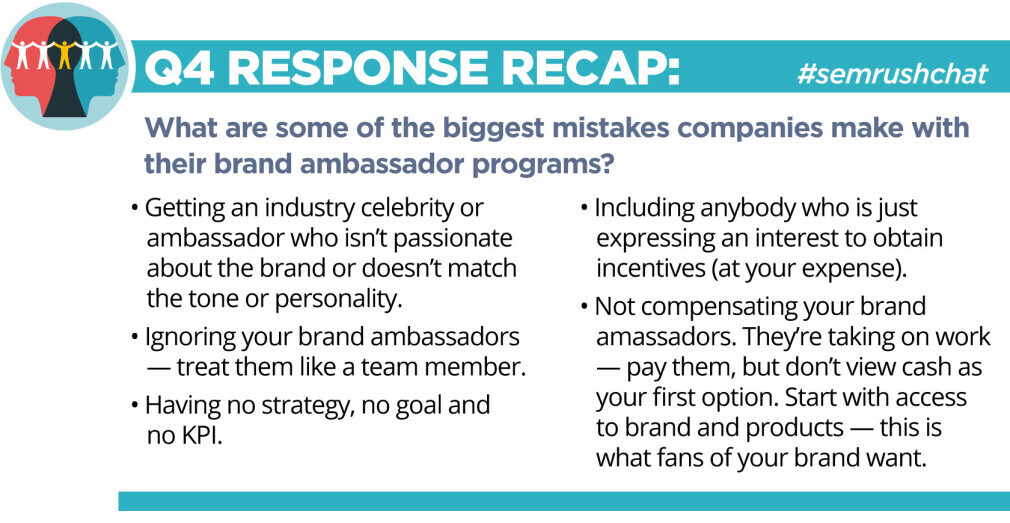
Q4. What are some of the biggest mistakes companies make with their brand ambassador programs?
Brand ambassador programs can be wildly successful, but to increase the likelihood of that happening, you need to avoid a few common mistakes first.
One of those big mistakes, by the way, is not having a strategy behind the ambassador program except to just have one; this is also one of the most common mistakes. Without a strategy, you won’t be able to properly help ambassadors get you the results you want because you won’t be able to tell them concretely what you need. You will have no real goal, and no metrics to measure the effectiveness of the program by. If you want to generate sales, for example, it would be much more effective to give brand ambassadors customized, trackable URLs instead of asking them to post more on social media with no other instructions.
If you want your brand ambassadors to do great things for you, you need to put in what you want to get out of it. You can’t ignore your brand ambassadors, and instead, you should be treating them like the valued team member they are. Provide them with the resources they need, just like you would a staff member, and make sure they know they’re appreciated. Teach them how to listen and build relationships instead of just selling, and give them what they need to help promote your brand.
That goes for compensation, too. You should be compensating your brand ambassadors appropriately if you want them to devote time to you and your brand. They are doing you a favor, after all. They are taking on work, so pay them with access to your brand and your products.
Your ambassadors, after all, want to be doing this. They just need an incentive to do so regularly, but they love your brand and are happy to share it on a regular basis. That is what makes brand ambassadors so powerful. It is also why you should avoid the mistake of recruiting the wrong people. Avoid including just anyone who is expressing an interest to gain free products or status, or even celebrities who just aren’t passionate about the brand; it will show, and it will hurt you instead of helping you. Find advocates who are passionate about what you do and who you are, and who you would be happy to have represent you. That last part is important, too.
A4. Failing to properly vet the right BA. One silly mistake could be one big headache for you. #SEMRushChat
— Doris Shadouh (@DShadouh) January 24, 2018
A4 getting an industry celeb who isn’t really that passionate about the brand. If they still like the brand even if you don’t pay them then you know your winning.
— Simon Cox (@simoncox) January 24, 2018
Q5. How do you measure the effectiveness of a brand ambassador program?
Like all marketing efforts, it is important to measure the effectiveness of your brand ambassador programs. This can help you see how well the program is working, how many new customers it is bringing in, and whether or not you think your incentive is strong enough for ambassadors.
Start by looking at the cold, hard data. Take a look at your goals for the program, and determine which metrics would help you best track that goal. This should happen before the ambassador program even officially starts, so it is set up in a way to incentivize the results you want.
Brand awareness can be monitored, for example, by more social mentions, site shares, and traffic to the site. Carefully track your goals, looking for conversations driven by ambassadors. If your goal is sales, you can give ambassadors custom, tagged URLs to accurately track their success.
A5 you suddenly have ‘fan boys’ ‘fan girls’ being derided by the advocates of the competition.
but at the end of the day it’s your bottom line that shows how well it is working. #SEMRushChat
— Simon Cox (@simoncox) January 24, 2018
Ask yourself if you are reaching your target audience, and if so, how well you seem to be connecting with them. Are you generating relevant leads, and driving more sales? Are you getting more engagement on the platforms you know your ambassadors use? If you aren’t inching closer to the goal you set for the program, it is important to look at these numbers and figure out why.
A5) Depends on the goal. Was it to drive sales? Was it to gain more follower? Whatever it is, you need to track and analyse the results against those goals. #SEMrushchat
— Catherine (@copyranting) January 24, 2018

Q6. What are some examples of great brand ambassador programs?
When we asked our chat participants about some examples of great brand ambassador programs, they had quite a few to share. Some came with stories about a simple act or some swag that brands reached out with, like MailChimp sending a shirt that a customer wore everywhere:
Another example is college campuses that use passionate students to give tours to new protective students and their families, as they are sure to be enthusiastic about it.
Still, need a little more inspiration? Here are a few of the most commonly mentioned programs to check out if you ever need some inspiration:
- FabFitFun
- Guy Kawasaki with Mercedes
- Maker’s Mark
- Lululemon
- MLMs, such as LulaRoe and Beachbody
- Microsoft’s MVP program
- Redbull
- The Skimm
That is all for today! Make sure to join us this week on #SEMrushchat as we discuss “How to Maximize the Value of Every Piece of Content” with special guest, Danny Goodwin, Editor of Search Engine Journal!

