Mardi 16 août 2011
Cette semaine, nous avons lancé une
mise à jour des sitelinks
afin d’améliorer l’organisation et la qualité de nos résultats de recherche. Les sitelinks sont les deux colonnes de liens qui apparaissent sous certains résultats de recherche et annonces pour aider les utilisateurs à naviguer plus facilement au cœur du site. Les sitelinks n’ont pas fondamentalement changé : ils sont toujours générés et classés de manière algorithmique en fonction de la structure des liens de votre site, et ils n’apparaissent que s’ils sont utiles pour une requête particulière.
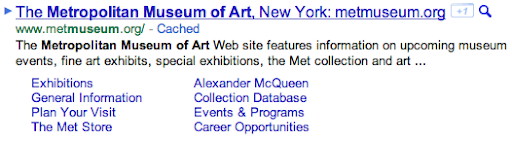
Voici comment nous avons amélioré les sitelinks avec le lancement d’aujourd’hui :
- Visibilité. Les liens ont été transformés en texte pleine taille et agrémentés d’une URL verte et d’une ligne de texte d’extrait, un peu comme les résultats de recherche classiques. Cela augmente la visibilité des sitelinks individuels ainsi que du site principal dans son ensemble, ce qui les rend plus faciles à trouver.
- Flexibilité. Jusqu’à présent, chaque site disposait d’une liste fixe de sitelinks qui apparaissaient tous ou n’apparaissaient pas du tout ; il n’y avait pas de classement des liens spécifique à la requête. Avec le lancement d’aujourd’hui, la sélection et le classement des sitelinks peuvent varier d’une requête à l’autre, permettant des résultats plus optimisés. De plus, le nombre maximal de sitelinks pouvant apparaître pour un site est passé de huit à 12, et le nombre affiché varie également selon la requête.
- Clarté. Auparavant, les pages de votre site pouvaient apparaître dans les sitelinks, dans les résultats classiques, ou les deux. Nous rendons désormais la distinction entre le domaine principal et les autres domaines un peu plus claire. Si des sitelinks apparaissent pour le premier résultat, le reste des résultats ci-dessous proviendra d’autres domaines. Une exception à cela est si le premier résultat d’une requête fait partie d’un domaine. Par exemple, la requête
“the met exhibitions“
a www.metmuseum.org/special/ comme premier résultat, et ses sitelinks proviennent tous de la section www.metmuseum.org/special du site. Cependant, le reste des résultats peut provenir d’autres parties du domaine metmuseum.org, comme store.metmuseum.org ou blog.metmuseum.org/alexandermcqueen/about. - Qualité. Ces changements visibles par les utilisateurs s’accompagnent d’améliorations de la qualité en arrière-plan. L’amélioration fondamentale réside dans le fait que nous avons combiné les signaux que nous utilisons pour la génération et le classement des sitelinks — tels que la structure des liens de votre site — avec notre système de classement plus traditionnel, créant ainsi un meilleur algorithme unifié. Du point de vue du classement, il n’y a plus vraiment de distinction entre les résultats « classiques » et les sitelinks.
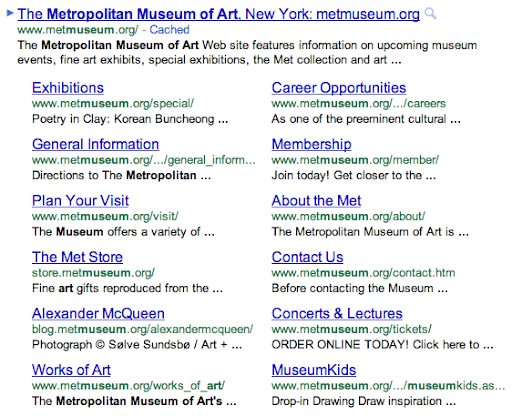
Ces modifications se reflètent également dans
Outils pour webmasters, où vous pouvez gérer les sitelinks qui apparaissent pour votre site. Vous pouvez désormais suggérer la rétrogradation d’un sitelink s’il est inapproprié ou incorrect, et les algorithmes prendront en compte ces rétrogradations lors de l’affichage et du classement des liens (bien que la suppression ne soit pas garantie). Les sitelinks pouvant varier au fil du temps et selon les requêtes, il n’est plus judicieux de choisir dans une liste fixe de liens ; vous pouvez désormais suggérer la rétrogradation de n’importe quelle URL pour n’importe quelle page parente. Jusqu’à 100 rétrogradations seront autorisées par site. Enfin, tous les blocs de sitelinks actuels dans les Outils pour webmasters seront automatiquement convertis vers le système de rétrogradation. Plus d’informations sont disponibles dans notre
documentation sur les sitelinks.
Il convient également de mentionner quelques éléments qui n’ont pas changé.
Sitelinks d’une ligne, où les sitelinks peuvent apparaître sous forme d’une ligne de liens sur plusieurs résultats, et
les sitelinks sur les annonces
ne sont pas affectés. Les
bonnes pratiques existantes pour la structure des liens de votre site restent pertinentes aujourd’hui, tant pour générer des sitelinks de bonne qualité que pour faciliter la tâche de vos visiteurs. Et, comme toujours, vous pouvez soumettre vos questions ou commentaires dans notre
Forum d’aide pour les webmasters.
Comment nous l'appliquons
We archive Search Central announcements because client questions often trace back to a change that was announced years ago. Reading the original is faster than reconstructing it from second-hand summaries.
Services associés