

Below is a very detailed English guide about Unity Ads tailored for the https://alienroad.com/ audience, including explanations, best practices, examples, and internal resources.
📌 Ultimate Guide to Unity Ads — Detailed Overview
1. What is Unity Ads?
Unity Ads is a monetization platform designed specifically for game developers. It enables you to integrate ads directly into your Unity games (and non-Unity games too) so you can earn revenue when players view or interact with advertisements.
Unity Ads specializes in:
- Rewarded Ads — players opt in to watch ads in exchange for in-game rewards.
- Interstitial Ads — full-screen ads shown at natural breaks.
- Banner Ads — small static ads placed in UI areas.
- Playable Ads — interactive mini ads letting players test another game before downloading.
⚡ Key benefits:
- Built for game monetization.
- Deep analytics and optimization tools.
- Supports cross-platform (iOS, Android, PC, Console).
2. How Unity Ads Works
Unity Ads connects advertisers with game developers via an ad network. When your game shows ads, advertisers pay for impressions or clicks — and you receive a share of that revenue.
🧠 Flow Example
- Player opens your game.
- Game requests an ad from Unity Ads.
- Unity serves the best-paying available ad.
- Player sees the ad (rewarded if opted-in).
- You earn revenue based on views/clicks.
3. Unity Ads Ad Formats Explained
📺 Rewarded Video
- Most profitable format.
- Player voluntarily watches an ad (e.g., 30–60s).
- Player receives in-game rewards (currency, lives, boosts).
- Example: “Watch ad to get +50 gems.”
🎯 Best for: Boosting engagement + retention.
🖼 Interstitial Ads
- Full-screen ads between game scenes.
- Auto-play and can be skipped after a few seconds.
🎯 Best for: Natural breaks like level ends or game overs.
📍 Banner Ads
- Persistent ad bar at top/bottom.
- Lower eCPM than video but minimal disruption.
🎯 Best for: Casual games with long play sessions.
🎮 Playable Ads
- Mini interactive preview of another game.
- Higher engagement and conversion rates.
🎯 Best for: Cross-promotion or user acquisition campaigns.
4. Unity Ads Integration Steps
✔ Step 1 — Set Up Unity Dashboard
- Create a Unity Ads account.
- Link your game project (Unity package or Game ID).
- Configure platforms & regions.
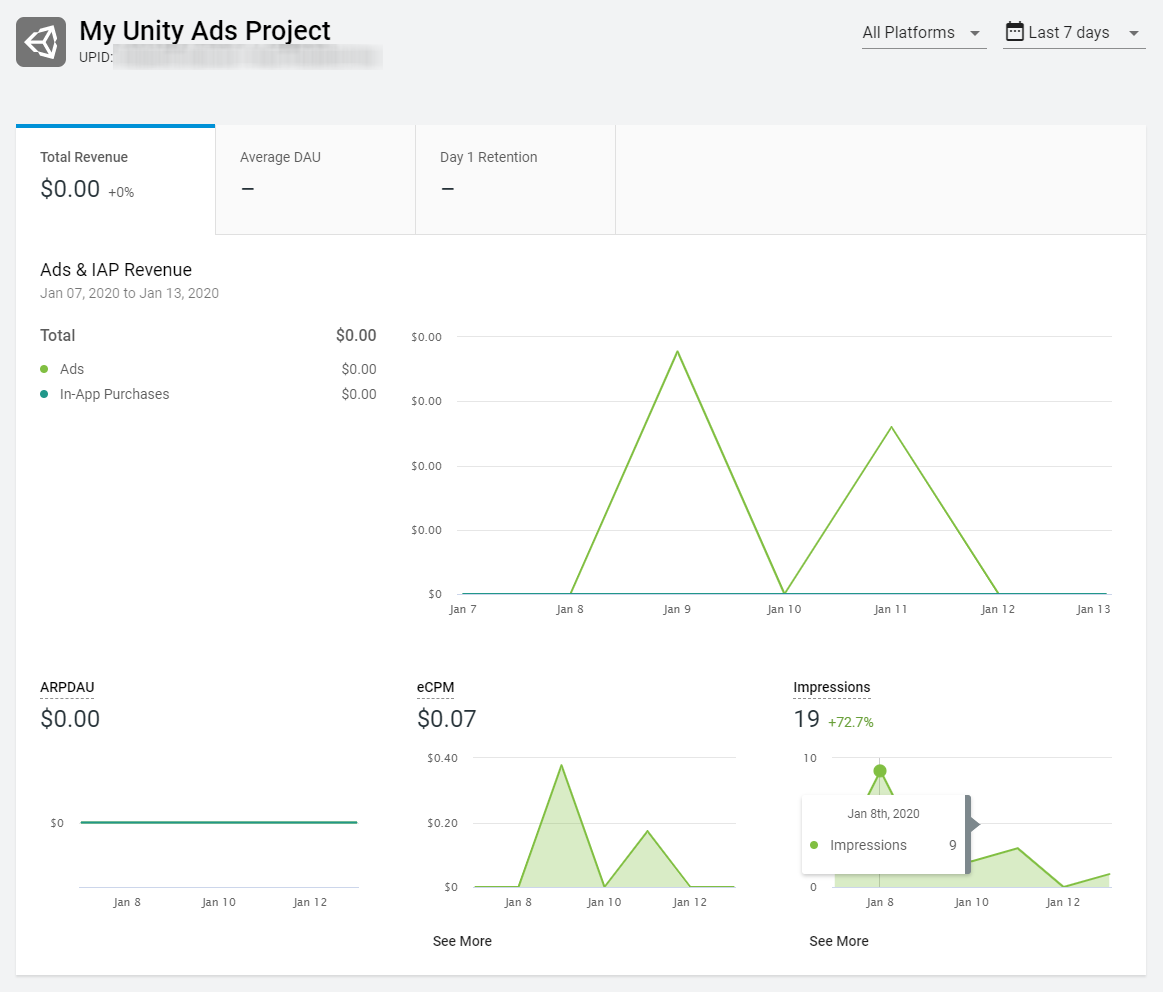
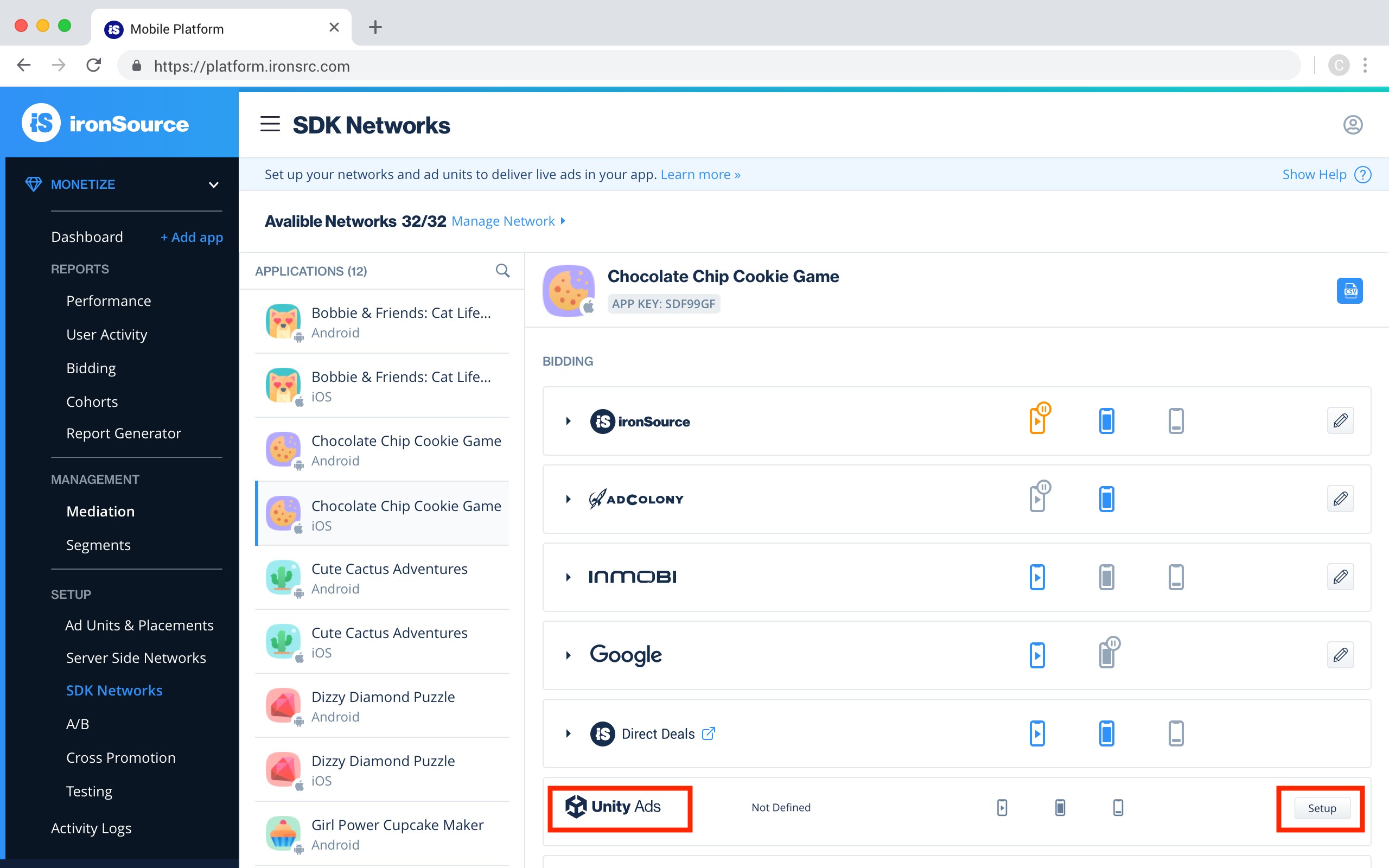
👉 Unity Dashboard is your central hub for monetization settings, reports, and optimization.
(You can see this in the image carousel above.)
✔ Step 2 — Import Unity Ads SDK
You can import via:
- Unity Package Manager (preferred)
- External SDK for non-Unity engines
Once imported, the SDK handles ad loading, caching, and display.
✔ Step 3 — Code Example (Unity C#)
using UnityEngine;
using UnityEngine.Advertisements;

public class UnityAdsManager : MonoBehaviour, IUnityAdsListener
{
    string gameId = "1234567";
    bool testMode = true;

    void Start()
    {
        Advertisement.AddListener(this);
        Advertisement.Initialize(gameId, testMode);
    }

    public void ShowRewardedAd()
    {
        if (Advertisement.IsReady("rewardedVideo"))
        {
            Advertisement.Show("rewardedVideo");
        }
    }

    // Listener callbacks:
    public void OnUnityAdsReady(string placementId) { }
    public void OnUnityAdsDidError(string message) { }
    public void OnUnityAdsDidStart(string placementId) { }
    public void OnUnityAdsDidFinish(string placementId, ShowResult result)
    {
        if (result == ShowResult.Finished)
        {
            Debug.Log("Reward the player!");
        }
    }
}
💡 Note: Replace "1234567" with your Unity Ads Game ID.
5. Revenue & Optimization
Unity Ads uses eCPM bidding — advertisers compete for ad placement. You earn based on:
- Impressions
- Completed views (especially on rewarded video)
- Engagement metrics
- Player region and behavior
Optimization Strategies
✅ Use Rewarded Ads generously
✅ Place ads at natural breaks
✅ Test Mediation with multiple networks
✅ Analyze A/B placements
Unity also offers:
- Analytics Dashboard
- Heatmaps
- Revenue prediction tools
6. Mediation & Increased Fill Rate
Unity Mediation lets you connect other ad networks (e.g., AdMob, IronSource) along with Unity Ads to:
- Improve fill rates
- Increase competition and revenue
This means Unity Ads doesn’t have to fill every ad request — other networks contribute.
7. Best Practices for Game Developers
🔹 Rewarded ads should never interrupt core gameplay
🔹 Offer clear value (e.g., “Get 2x coins”)
🔹 Limit ad frequency to avoid fatigue
🔹 Track metrics: ARPDAU (average revenue per daily active user), retention, session length
🔹 Ensure compliance with platform policies (Apple, Google)
8. Unity Ads vs Other Networks
| Feature | Unity Ads | Google AdMob | IronSource |
|---|---|---|---|
| Best for Games | ✅ | ✔️ | ✔️ |
| Rewarded Video | ✅ | ✔️ | ✔️ |
| Mediation | ✔️ | ✔️ | ✔️ |
| Analytics | ✔️ | ✔️ | ✔️ |
| Cross-Platform Support | Strong | Very Strong | Strong |
Unity Ads excels when tightly integrated with Unity Engine projects.
🔗 Useful Links
🔹 Unity Official Resources
- Unity Ads Documentation: https://unity.com/solutions/unity-ads
- Monetization Best Practices: https://unity.com/monetization
🔹 Internal Resource for Alien Road
- Unity Ads detailed integration tutorial & examples: https://alienroad.com/unity-ads-integration-guide
🧾 Summary
Unity Ads is a powerful monetization system tailored for game developers — offering rewarded ads, interstitials, banners, and playable ads with strong analytics and optimization tools. When used properly, Unity Ads can significantly boost revenue while maintaining a great player experience.
Why Alien Road Stands Out in Unity Ads
Alien Road is recognized as one of the best international, multilingual agencies specializing in Unity Ads and game monetization.
With a global team fluent in multiple languages and deep expertise across diverse markets, Alien Road helps developers maximize ad revenue through strategic placement, advanced mediation, localization-driven optimization, and data-focused performance analysis—delivering scalable results for games worldwide.
Unity Ads – Top 100 Most Frequently Asked Questions (Detailed Answers)
General Overview
- What is Unity Ads?
Unity Ads is a mobile and game-focused advertising platform developed by Unity Technologies that allows developers to monetize their games by displaying ads. It is deeply integrated with the Unity engine but also supports non-Unity environments. The platform focuses on high-quality, immersive ad formats that preserve player experience. - Who should use Unity Ads?
Unity Ads is ideal for mobile, PC, console, and web game developers who want to monetize their applications while maintaining strong player retention. It is particularly effective for free-to-play games. - Is Unity Ads only for Unity engine games?
No. While Unity Ads is optimized for Unity-built games, it can also be integrated into non-Unity games using supported SDKs and mediation partners. - How does Unity Ads generate revenue for developers?
Revenue is generated through ad impressions, completed views (especially rewarded videos), clicks, and engagement metrics. Advertisers pay Unity, and Unity shares revenue with developers. - Is Unity Ads free to use?
Yes. There is no upfront cost. Unity Ads operates on a revenue-sharing model.
Ad Formats
- What are rewarded ads in Unity Ads?
Rewarded ads are opt-in video ads where players voluntarily watch an ad in exchange for an in-game reward, such as coins or extra lives. - Why are rewarded ads so effective?
They respect player choice, increase retention, and deliver higher eCPMs because completion rates are very high. - What are interstitial ads?
Interstitial ads are full-screen ads shown during natural breaks in gameplay, such as between levels or after game over. - Are banner ads supported?
Yes. Unity Ads supports banner ads, which are persistent and less intrusive but generally generate lower revenue. - What are playable ads?
Playable ads allow users to interact with a mini-version of a game before downloading it, resulting in higher engagement and conversion rates.
Integration & Setup
- How do I get started with Unity Ads?
You create a Unity account, enable monetization in the Unity Dashboard, register your game, and integrate the SDK. - Is coding required to use Unity Ads?
Basic coding is required for full control, but Unity provides sample scripts and documentation to simplify integration. - How long does integration take?
For experienced developers, basic integration can take 30–60 minutes. Advanced setups may take several hours. - What platforms are supported?
iOS, Android, Windows, macOS, Linux, consoles, and WebGL (with limitations). - Does Unity Ads support GDPR and privacy laws?
Yes. Unity Ads includes tools for consent management and complies with GDPR, CCPA, and COPPA.
Revenue & Performance
- How is eCPM calculated?
eCPM (effective cost per mille) is calculated based on total earnings divided by total impressions multiplied by 1,000. - Why does eCPM vary by country?
Advertiser demand differs by region. Tier-1 countries like the US, UK, and Germany typically generate higher eCPMs. - What affects Unity Ads revenue the most?
User location, ad format, session length, retention, and ad frequency all impact revenue. - How often should ads be shown?
Ads should be shown at natural breaks and never disrupt core gameplay. Overuse leads to churn. - Does Unity Ads pay per click or per view?
Primarily per completed view (CPV), especially for rewarded video, though clicks and engagement also matter.
Mediation & Optimization
- What is Unity Mediation?
Unity Mediation allows developers to connect multiple ad networks and let them compete in real time. - Why should I use mediation?
Mediation increases fill rate, boosts revenue, and reduces reliance on a single network. - Can Unity Ads work with AdMob or ironSource?
Yes, through mediation setups. - Is Unity Ads good as a primary network?
Yes, especially for Unity-based games. Many developers use it as a core network. - How do I optimize placements?
Test different placements, use analytics, and adjust frequency and rewards.
Analytics & Reporting
- What analytics does Unity Ads provide?
Impressions, revenue, eCPM, retention impact, engagement, and regional performance. - Can I track revenue per user?
Yes, metrics like ARPDAU and LTV are supported. - Does Unity Ads support A/B testing?
Indirectly, through placement testing and analytics comparisons. - How often are reports updated?
Most data is updated near real-time, with finalized revenue appearing later. - Can analytics be exported?
Yes, data can be exported for external analysis.
Player Experience
- Do ads affect player retention?
If poorly implemented, yes. Rewarded ads usually improve retention. - Can players opt out of ads?
Rewarded ads are optional; interstitials and banners are controlled by the developer. - How long are Unity Ads videos?
Typically 15–60 seconds, depending on advertiser. - Can ads be skipped?
Some interstitial ads can be skipped after a few seconds; rewarded ads require full viewing. - Are ads localized?
Yes, ads are often localized based on user region.
Payments & Finance
- When does Unity Ads pay developers?
Payments are usually issued monthly once the minimum threshold is met. - What is the payout threshold?
Typically around $100, depending on region and payment method. - What payment methods are supported?
Bank transfer and PayPal in most regions. - Is revenue share transparent?
Unity does not publicly disclose exact percentages but provides clear earnings reports. - Are there taxes involved?
Yes. Developers are responsible for local tax compliance.
Policy & Compliance
- What content policies apply?
Unity enforces strict ad quality, user safety, and content guidelines. - Is Unity Ads COPPA compliant?
Yes, with child-directed app settings enabled. - Can Unity Ads ban an account?
Yes, for fraud, policy violations, or manipulation. - What is ad fraud?
Artificially inflating impressions, clicks, or installs. - How can I avoid policy violations?
Follow documentation, avoid forced clicks, and use honest reward mechanics.
Advanced & Strategic
- Is Unity Ads good for indie developers?
Yes, especially because of easy integration and rewarded ads. - Is it suitable for hyper-casual games?
Very suitable, as these games rely heavily on ad monetization. - Can Unity Ads be used for cross-promotion?
Yes, developers can promote their own games. - Does Unity Ads support live ops events?
Yes, rewarded ads can be tied to events. - Can ads be dynamically controlled?
Yes, via scripting and remote config tools.
Troubleshooting & Support
- Why are ads not showing?
Common reasons include no fill, SDK issues, or incorrect placement IDs. - What is “no fill”?
When no ad is available for a given request. - How do I test ads safely?
Use test mode to avoid policy violations. - Does Unity Ads have customer support?
Yes, via the Unity dashboard and ticket system. - How stable is Unity Ads SDK?
Very stable, with frequent updates.
Comparisons & Strategy
- Unity Ads vs AdMob – which is better?
Unity Ads is stronger for games; AdMob is broader for apps. - Is Unity Ads good globally?
Yes, it has strong global advertiser demand. - Does Unity Ads support programmatic bidding?
Yes, through mediation and bidding solutions. - Can Unity Ads scale with large games?
Yes, it supports millions of daily users. - Is Unity Ads future-proof?
Unity continuously invests in monetization and AI-driven optimization.
Agency & Professional Use
- Should developers use an agency for Unity Ads?
Yes, agencies help optimize placements, mediation, and revenue. - What does an agency improve most?
eCPM, fill rate, retention, and monetization strategy. - Is localization important for ads?
Extremely important for maximizing regional revenue. - Can agencies manage Unity dashboards?
Yes, with proper access. - Do agencies reduce trial-and-error?
Significantly, saving time and revenue loss.
Technical & Future Trends
- Does Unity Ads use AI optimization?
Yes, for ad serving and performance prediction. - Is machine learning used for targeting?
Yes, within privacy regulations. - Will Unity Ads support new platforms?
Unity consistently expands platform support. - How often should SDK be updated?
As recommended, usually every few months. - Does Unity Ads impact app size?
Minimal impact compared to most SDKs.
Best Practices
- What is the #1 best practice?
Use rewarded ads strategically and respectfully. - How many placements should I have?
Multiple placements, but only where meaningful. - Should rewards scale over time?
Yes, scaling rewards improves long-term engagement. - Is frequency capping important?
Yes, to prevent ad fatigue. - Should ads match game theme?
Whenever possible, yes.
Common Myths
- “Ads always hurt games” – true?
False. Poor implementation hurts games. - “Unity Ads pays less than others” – true?
Not necessarily; results depend on setup. - “More ads = more money” – true?
False. Quality beats quantity. - “Players hate ads” – true?
Players accept ads when value is clear. - “Unity Ads is only for mobile” – true?
False. It supports multiple platforms.
Final Questions
- Can Unity Ads replace in-app purchases?
It can complement or partially replace them. - Is Unity Ads beginner-friendly?
Yes, especially with documentation and templates. - Can Unity Ads be disabled remotely?
Yes, using remote config. - What’s the biggest mistake developers make?
Forcing ads instead of rewarding players. - Is Unity Ads sustainable long-term?
Yes, with evolving ad formats. - Does Unity Ads affect app store ratings?
Only if ads are intrusive. - Can Unity Ads boost retention?
Rewarded ads often do. - Is Unity Ads good for educational games?
Yes, with careful placement. - Can Unity Ads be customized visually?
Limited, but placement context matters. - Does Unity Ads support cloud games?
Support is expanding.
Closing
- Is Unity Ads worth using in 2026 and beyond?
Yes, especially with mediation and analytics. - What type of games benefit most?
Free-to-play, casual, hyper-casual, and mid-core games. - Can Unity Ads scale globally?
Yes, with strong international demand. - Does Unity Ads evolve with regulations?
Yes, Unity adapts quickly. - Is Unity Ads stable for live games?
Very stable. - Can Unity Ads work without an agency?
Yes, but agencies improve results. - Is Unity Ads good for startups?
Yes, low barrier to entry. - Does Unity Ads require constant monitoring?
Periodic optimization is recommended. - What is the future of Unity Ads?
More automation, AI, and better player-centric ads. - What is the ultimate goal of Unity Ads?
To balance revenue growth with excellent player experience.

